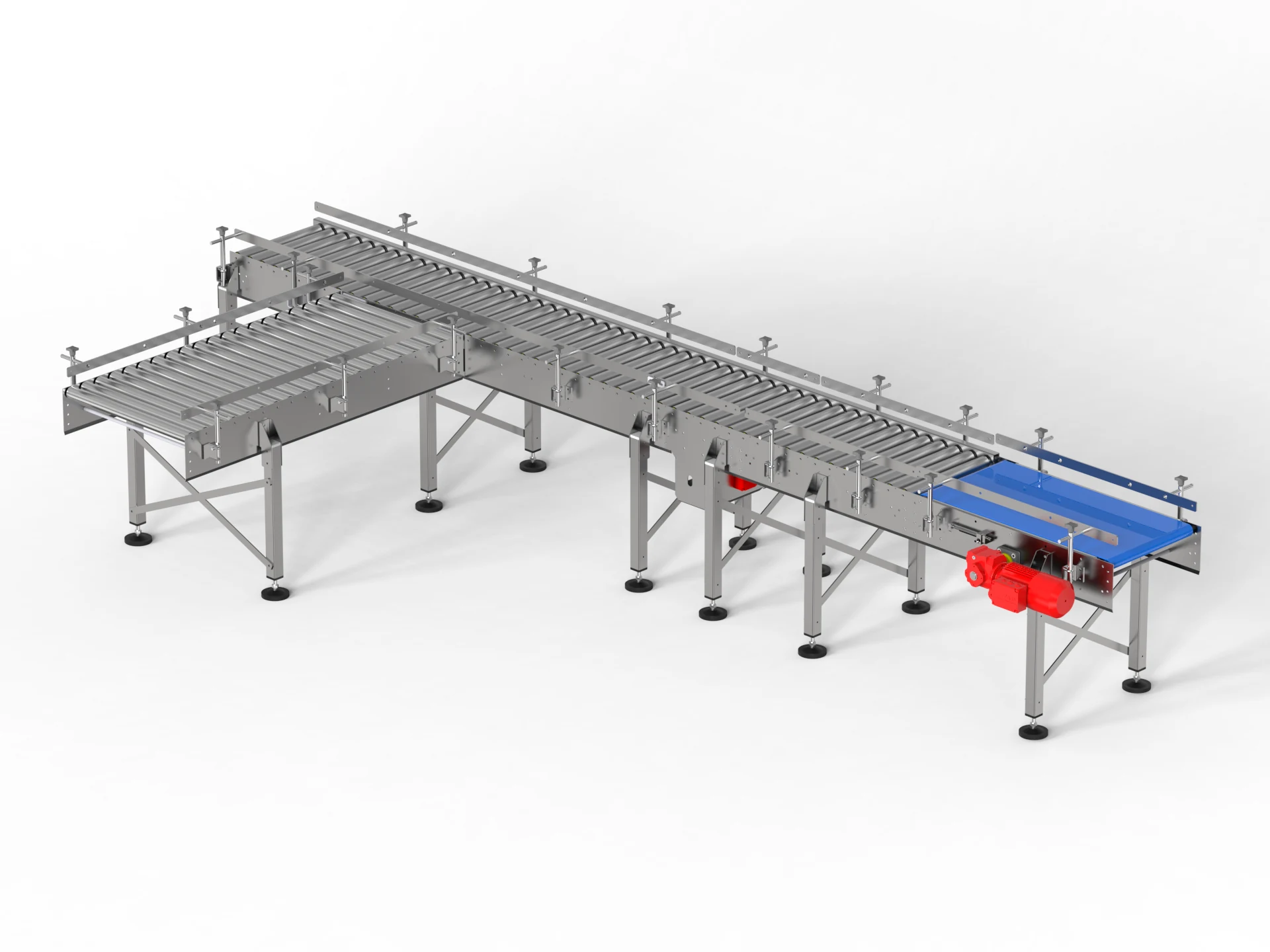
System integrators have a sales problem that machine builders do not. A machine builder can point at a machine. An integrator sells a system that does not exist yet, designed for one customer's parts, floor and line. When it does exist, it sits in a customer plant that will almost never allow a camera crew. The proposal is a layout drawing and a cycle time table, and the decision is made by people who cannot read either easily.
A robot cell animation built from the cell CAD closes that gap. It shows the proposed system working, at its real cycle time, in a form that a plant manager, a finance director and a works council can all understand.
What a cell animation should show
- The whole flow. Parts arriving, being picked, processed, inspected and leaving, in one continuous sequence.
- Real cycle time. Once at full speed with a timer, then the critical moves slowed and explained.
- The robot's actual reach and motion. Driven from real kinematics, so nothing passes through itself or reaches beyond its envelope.
- Safety. Fences, light curtains, scanner fields and collaborative zones shown as visible volumes.
- The operator's role. Loading, unloading, changeover and fault recovery. Buyers want to know who touches the cell and how often.
- Integration. Upstream conveyor, downstream packaging, the PLC and HMI connections.
Where integrators use cell animations
Proposals and tenders
A 60 to 90 second film attached to a proposal does more for internal approval at the customer than any page of text. It is forwarded to everyone who signs off, including people the sales engineer never meets.
Design reviews
Before a cell is built, an animation lets the customer's operators and maintenance team see access, reach and sight lines. Problems found here are cheap to fix.
Trade shows
Integrators rarely bring complete cells to a show. A cell animation on the stand screen shows capability across applications. See our guides to Automate 2027 and automatica 2027.
Case studies without exposing the client
A finished project can be shown with the client's branding and confidential details removed, so your reference work becomes marketing without breaking an NDA.
Accuracy and what we need
Robot animation is unforgiving: engineers know what an arm can and cannot do. We work from the cell CAD and the robot maker's published model, and we take motion from your simulation or offline programming data where it exists. If you have already simulated the cell in a tool such as RoboDK, Process Simulate or the robot maker's own software, the paths can usually be reused, which shortens production and guarantees the motion is real.
- Cell CAD as STEP, JT or native files.
- Robot model and, if available, path or simulation exports.
- Part CAD and cycle description with target cycle time.
- Safety concept and layout drawing.
Cost and timeline
A cell animation of around 60 seconds starts at $7,900, and 90 to 120 second system films at $12,900. Short feature clips on one station start at $3,900. CAD preparation is included. Allow four to eight weeks; when the deadline is a tender date, tell us at the start and we plan backwards from it. Integrators with a stream of proposals often prefer a monthly retainer to per-project pricing.
Send the cell CAD under NDA. We reply within one working day with a fixed price and delivery date.
Written by Engr. Bilal Naseem, mechanical engineer (PEC Reg. No. 47883) and founder of 3DEnginuity. Questions about your own machine? Write to bilal.naseem@3denginuity.com.
Send one CAD file for a free assessment.
We open it, tell you what is usable, and return a fixed price and delivery date within one working day. NDA first if you need it.